"The peoples of many countries are being taxed to the point of poverty and starvation in order to enable governments to engage in a mad race in armament which, if permitted to continue, may well result in war. This grave menace to the peace of the world is due in no small measure to the uncontrolled activities of the manufacturers and merchants of engines of destruction, and it must be met by a concerted action of the peoples of all nations." Franklin D. Roosevelt
Showing posts with label WWI. Show all posts
Showing posts with label WWI. Show all posts
Tuesday, March 22, 2011
Dealers in Death (1935)
This 1935 anti-war documentary tells the story of the companies that became rich selling weapons in World War I. It also looked into the years that lay ahead.


Monday, January 17, 2011
Mud and Rain By Siegfried Sassoon
This is a poem by British Poet Siegfried Sassoon about the Battle of Paschendale.
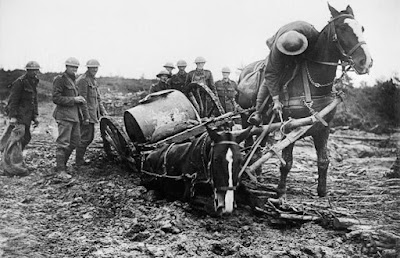
Mud and Rain
Mud and rain and wretchedness and blood.
Why should jolly soldier-boys complain?
God made these before the roofless Flood -
Mud and rain.
Mangling cramps and bullets through the brain,
Jesus never guessed them when He died.
Jesus had a purpose for His pain,
Ay, like abject beasts we shed our blood,
Often asking if we die in vain.
Gloom conceals us in a soaking sack --
Mud and rain.

Mud and Rain
Mud and rain and wretchedness and blood.
Why should jolly soldier-boys complain?
God made these before the roofless Flood -
Mud and rain.
Mangling cramps and bullets through the brain,
Jesus never guessed them when He died.
Jesus had a purpose for His pain,
Ay, like abject beasts we shed our blood,
Often asking if we die in vain.
Gloom conceals us in a soaking sack --
Mud and rain.
Saturday, January 15, 2011
Gallipoli
A moving and disturbing documentary about the Gallipoli campaign of WWI. In this months long battle of attrition, British, French and ANZAC (Australian and New Zealand Army Corps.) forces faced off against Turkish and German troops. The Turks were dug into trenches on the high ground and both sides suffered horrible casualties amidst appaling conditions. Gallipoli was the largest amphibious military operation ever attempted up to that time. It was also one of the most tragic failures experienced by the Allies during the war and was ultimately responsible for Winston Churchill losing his position as First Lord of the Admiralty.
This film was a joint Australian and Turkish production, so it does an excellent job of giving both sides of this story. This film is also available on Netflix here.
UPDATE:
The old links are broken unfortunately, but here is another Documentary about Gallipoli available on youTube (at least for now)
This film was a joint Australian and Turkish production, so it does an excellent job of giving both sides of this story. This film is also available on Netflix here.
UPDATE:
The old links are broken unfortunately, but here is another Documentary about Gallipoli available on youTube (at least for now)
Thursday, December 30, 2010

WWI Propaganda Posters.
A really nice collection of WWI propaganda posters can be found here, along with a ton of great historical information as well!

Never mind the Hun, we want our money!
Excerpts from A World Undone (G.J. Meyer)
from the Chapter: Background: Consuming the Future

In addition to being the greatest bloodbath in the history of western Europe and the greatest in eastern Europe until the Second World War, the Great War was a process by which all the great powers, victors and vanquished alike, transformed themselves from bastions of prosperity into sinkholes of poverty and debt. Financially as in so many other ways, the war was a road to ruin....
What was not foreseen was the ability of the industrialized nations to go on fighting year after year even while devouring themselves financially. As astute an economist as John Maynard Keynes was a year into the Great War before he understood that total war would not cause total financial collapse. “As long as there are goods and labor in the country the government can buy them with banknotes,” he wrote in September 1915, “and if the people try to spend the notes, an increase in their real consumption is immediately checked by a corresponding rise of prices.” The truth, he concluded, was that bankruptcy would never force the great powers to stop fighting. They could be stopped only by the exhaustion of their manpower, their physical resources, or their will to continue. The next few years showed him to be entirely right....
Great nations found themselves unable not only to pay their bills but even, in some cases, to pay the interest on what they were borrowing. By 1917 the German government’s expenditures amounted to 76 percent of net national product; they had been 18 percent just before the war. Tax revenues were covering only 8 percent of the spending. That same year Britain’s military spending was 70 percent of national output, and revenues were about a fourth of expenses. France’s military budget, thanks to heavy borrowing, was equal to or even more than total output....
The British and French were far more able than the Germans to repatriate money they had invested overseas, and because of the naval blockade only the Entente was able to buy and borrow from the United States. But gradually, inexorably, their treasuries were depleted. Questions arose in New York and Washington about their ability to make good on their debt. In November 1916 the U.S. Federal Reserve Board warned its member banks against continuing to buy foreign—which meant British and French—treasury bills. The result was a near-panic in which London retaliated by briefly ceasing to place orders in the United States and urged France to do likewise. By April 1917 the British were spending $75 million a week in the United States, were overdrawn on their American accounts by $358 million, and had only $490 million in securities and $87 million in gold to draw on to make good their debt. In short, they were only weeks away from insolvency.
But this was a crisis for the United States too. American manufacturers and farmers had become dependent on sales to the Entente, and American banks were owed immense amounts. A British and French financial collapse—never mind the outright defeat of the two nations—would have been a disaster for the U.S. economy. Thus the German submarines were not Washington’s only reason for wanting to save the Entente. In purely practical business terms, it became dangerous for the United States not to enter the war.
The following is from ZeroHedge :
The Congressional Budget Office (CBO) on Dec. 14 projects that under current law, debt held by the public will exceed $16 trillion by 2020, reaching nearly 70% of GDP. The CBO also projects the combination of rising debt and rising interest rates to cause net interest payments to balloon to nearly $800 billion, or 3.4% of GDP, by 2020 (Fig. 2).
Monday, September 13, 2010
World War I in Colour - War is pointless.
Footage of troops fighting in the trenches of WWI. More like this to follow.
And here is a video that shows the human toll of trench warfare. Warning this video is disturbing.
World War I was the first modern global military conflict which took place in Europe between 1914 to 1918. Archaic military tactics met modern industrialised warfare for the first time, resulting casualties on a previously unimaginable scale. Men rotted in the mud, then were sent to face massed machine gun fire, modern artillary, tanks and chemical weapons. Approximately 16 million soldiers and civilians died and countless others were physically maimed or mentally scarred by the horrors of trench warfare.via sconicbomb
Music: Clint Mansell - The Last Man
And here is a video that shows the human toll of trench warfare. Warning this video is disturbing.
Tuesday, August 31, 2010
Otto Dix - War Images
Otto Dix (1891-1969) via Encyclopedia of Irish & World Art
The German painter and printmaker Wilhelm Heinrich Otto Dix was one of the greatest and most powerful representatives of the post-war satirical style of German Expressionism, which flourished during the 1920s in Berlin, Dresden, Mannheim and other major cities. The target for Dix's satirical, often brutal style of expressionism was the horror of war, of which he had first-hand experience, and the decadent depravities of the post-war Weimar Republic. A member of Die Neue Sachlichkeit (New Objectivity) school, Dix was banned by the Nazis who classified his art as degenerate. Acknowledged as one of the greatest post-war expressionist painters, his 1920s paintings are regarded as some of the finest anti-war pictures of modern art.
 |
| The Trench |
 |
| Stormtroopers Advancing Under Gas - 1924 |
 |
| Machine Gunner Advancing |
 |
| Meal Time in the Trenches - 1923/24 |
 |
| Trenches - 1917 |
 |
| Flandern - 1934 |
Monday, August 30, 2010
War Is A Racket, by Major General Smedley Butler, 1935
War Is A Racket, by Major General Smedley Butler, 1935
via Howard Zinn's 'Voices of a People's History'
And what is this bill?
This bill renders a horrible accounting. Newly placed gravestones. Mangled bodies. Shattered minds. Broken hearts and homes. Economic instability. Depression and all its attendant miseries. Back-breaking taxation for generations and generations.
For a great many years, as a soldier, I had a suspicion that war was a racket; not until I retired to civil life did I fully realize it. Now that I see the international war clouds gathering, as they are today, I must face it and speak out.'
via Howard Zinn's 'Voices of a People's History'
'Out of war nations acquire additional territory, if they are victorious. They just take it. This newly acquired territory promptly is exploited by the few -- the selfsame few who wrung dollars out of blood in the war. The general public shoulders the bill.
And what is this bill?
This bill renders a horrible accounting. Newly placed gravestones. Mangled bodies. Shattered minds. Broken hearts and homes. Economic instability. Depression and all its attendant miseries. Back-breaking taxation for generations and generations.
For a great many years, as a soldier, I had a suspicion that war was a racket; not until I retired to civil life did I fully realize it. Now that I see the international war clouds gathering, as they are today, I must face it and speak out.'

A Farewell to Arms by Ernest Hemingway - eBook
A Farewell to Arms by Ernest Hemingway - eBook
The full text of Ernest Hemingway's classic book about World War I

The full text of Ernest Hemingway's classic book about World War I
Subscribe to:
Posts (Atom)