A moving and disturbing documentary about the Gallipoli campaign of WWI. In this months long battle of attrition, British, French and ANZAC (Australian and New Zealand Army Corps.) forces faced off against Turkish and German troops. The Turks were dug into trenches on the high ground and both sides suffered horrible casualties amidst appaling conditions. Gallipoli was the largest amphibious military operation ever attempted up to that time. It was also one of the most tragic failures experienced by the Allies during the war and was ultimately responsible for Winston Churchill losing his position as First Lord of the Admiralty.
This film was a joint Australian and Turkish production, so it does an excellent job of giving both sides of this story. This film is also available on Netflix here.
UPDATE:
The old links are broken unfortunately, but here is another Documentary about Gallipoli available on youTube (at least for now)
Showing posts with label Germany. Show all posts
Showing posts with label Germany. Show all posts
Saturday, January 15, 2011


Thursday, December 30, 2010

WWI Propaganda Posters.
A really nice collection of WWI propaganda posters can be found here, along with a ton of great historical information as well!

Tuesday, November 2, 2010
Allies Fight Fierce Nazi Counter-Blow,1944/12/20 (1944)
More newsreel footage from WWII. Features footage captured from German sources.
"Optimism was absent from the German command. In September 1944, as the Russians halted their advance on Warsaw and the Allies stalled in Holland in Operation Market-Garden, Hitler stunned his generals with a bold plan reminiscent of the 1940 campaign. Panzer divisions backed by Volksturm units would smash through the weakly defended Ardennes and head for Antwerp, cutting off the Allied supply lines. Special English-speaking units in modified German armor and captured American equipment would range out ahead of the Panzers, causing confusion and creating fear among the ranks.The bold plan included a large, desperate attack by the remaining Luftwaffe units on the Allied airfields."
read more here.
"Optimism was absent from the German command. In September 1944, as the Russians halted their advance on Warsaw and the Allies stalled in Holland in Operation Market-Garden, Hitler stunned his generals with a bold plan reminiscent of the 1940 campaign. Panzer divisions backed by Volksturm units would smash through the weakly defended Ardennes and head for Antwerp, cutting off the Allied supply lines. Special English-speaking units in modified German armor and captured American equipment would range out ahead of the Panzers, causing confusion and creating fear among the ranks.The bold plan included a large, desperate attack by the remaining Luftwaffe units on the Allied airfields."
read more here.
Monday, November 1, 2010
Saturday, October 9, 2010
The red flag over the Reichstag, Berlin
Yevgeni Khaldei's iconic photo of the Soviet Red Flag being hoisted above the Reichstag during the fall of berlin.

read more here.

read more here.
Thursday, October 7, 2010
WWII, in color!
Some really amazing color photos from WWII. via English Russia. A very fascinating web site all around!


See more here.

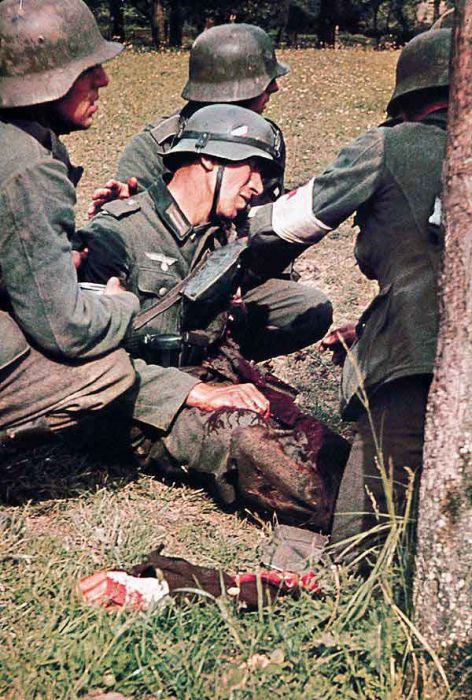


See more here.
Monday, September 13, 2010
World War I in Colour - War is pointless.
Footage of troops fighting in the trenches of WWI. More like this to follow.
And here is a video that shows the human toll of trench warfare. Warning this video is disturbing.
World War I was the first modern global military conflict which took place in Europe between 1914 to 1918. Archaic military tactics met modern industrialised warfare for the first time, resulting casualties on a previously unimaginable scale. Men rotted in the mud, then were sent to face massed machine gun fire, modern artillary, tanks and chemical weapons. Approximately 16 million soldiers and civilians died and countless others were physically maimed or mentally scarred by the horrors of trench warfare.via sconicbomb
Music: Clint Mansell - The Last Man
And here is a video that shows the human toll of trench warfare. Warning this video is disturbing.
Friday, September 3, 2010
'Peak Oil' and the German Government
via Der Spiegel
 According to the German report, there is "some probability that peak oil will occur around the year 2010 and that the impact on security is expected to be felt 15 to 30 years later." The Bundeswehr prediction is consistent with those of well-known scientists who assume global oil production has either already passed its peak or will do so this year....
The political and economic impacts of peak oil on Germany have now been studied for the first time in depth. The crude oil expert Steffen Bukold has evaluated and summarized the findings of the Bundeswehr study. Here is an overview of the central points:

The political and economic impacts of peak oil on Germany have now been studied for the first time in depth. The crude oil expert Steffen Bukold has evaluated and summarized the findings of the Bundeswehr study. Here is an overview of the central points:
- Oil will determine power: The Bundeswehr Transformation Center writes that oil will become one decisive factor in determining the new landscape of international relations: "The relative importance of the oil-producing nations in the international system is growing. These nations are using the advantages resulting from this to expand the scope of their domestic and foreign policies and establish themselves as a new or resurgent regional, or in some cases even global leading powers."
- Increasing importance of oil exporters: For importers of oil more competition for resources will mean an increase in the number of nations competing for favor with oil-producing nations. For the latter this opens up a window of opportunity which can be used to implement political, economic or ideological aims. As this window of time will only be open for a limited period, "this could result in a more aggressive assertion of national interests on the part of the oil-producing nations."
- Politics in place of the market: The Bundeswehr Transformation Center expects that a supply crisis would roll back the liberalization of the energy market. "The proportion of oil traded on the global, freely accessible oil market will diminish as more oil is traded through bi-national contracts," the study states. In the long run, the study goes on, the global oil market, will only be able to follow the laws of the free market in a restricted way. "Bilateral, conditioned supply agreements and privileged partnerships, such as those seen prior to the oil crises of the 1970s, will once again come to the fore."
- Market failures: The authors paint a bleak picture of the consequences resulting from a shortage of petroleum. As the transportation of goods depends on crude oil, international trade could be subject to colossal tax hikes. "Shortages in the supply of vital goods could arise" as a result, for example in food supplies. Oil is used directly or indirectly in the production of 95 percent of all industrial goods. Price shocks could therefore be seen in almost any industry and throughout all stages of the industrial supply chain. "In the medium term the global economic system and every market-oriented national economy would collapse."
- Relapse into planned economy: Since virtually all economic sectors rely heavily on oil, peak oil could lead to a "partial or complete failure of markets," says the study. "A conceivable alternative would be government rationing and the allocation of important goods or the setting of production schedules and other short-term coercive measures to replace market-based mechanisms in times of crisis."
- Global chain reaction: "A restructuring of oil supplies will not be equally possible in all regions before the onset of peak oil," says the study. "It is likely that a large number of states will not be in a position to make the necessary investments in time," or with "sufficient magnitude." If there were economic crashes in some regions of the world, Germany could be affected. Germany would not escape the crises of other countries, because it's so tightly integrated into the global economy.
- Crisis of political legitimacy: The Bundeswehr study also raises fears for the survival of democracy itself. Parts of the population could perceive the upheaval triggered by peak oil "as a general systemic crisis." This would create "room for ideological and extremist alternatives to existing forms of government." Fragmentation of the affected population is likely and could "in extreme cases lead to open conflict."
Wednesday, September 1, 2010
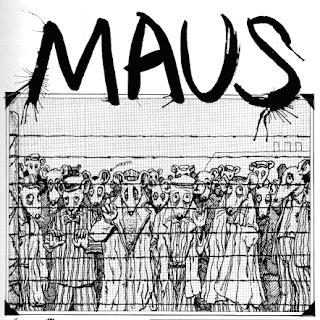
MAUS: A Survivor's Tale by Art Spiegelman
This is one of the most chilling descriptions of the Holocaust story I have ever read or seen depicted in any medium. It shook me up. I can't recommend it enough.



.png)
note: this is a preview version and may be incomplete
.png)
Stalingrad - Movie 1993

Stalingrad is a 1993 film by Joseph Vilsmaier, which depicts the horrors of combat on the Eastern Front of World War II in a realistic and unromanticized fashion.
The movie follows a naïve platoon of German Army soldiers as they are transferred from Italy and recent experiences inNorth Africa, to Russia where they ultimately find themselves unwilling participants in the Battle of Stalingrad.
read more here
Note: This movie is in German
Dateline 1939: German Forces Invade Poland
Invasion of Poland - WWII Begins
 The Invasion of Poland, also known as the September Campaign or 1939 Defensive War (Polish: Kampania wrześniowa or Wojna obronna 1939 roku) in Poland and the Poland Campaign (German: Polenfeldzug) in Germany, was an invasion of Poland by Germany, the Soviet Union, and a small Slovak contingent that marked the start of World War II. The invasion began on 1 September 1939, one week after the signing of the Molotov–Ribbentrop Pact, and ended 6 October 1939 with Germany and the Soviet Union dividing and annexing the whole of Poland.
read more here.
Here is the British Version:
Here is the German one:

read more here.
Here is the British Version:
Here is the German one:
Subscribe to:
Posts (Atom)